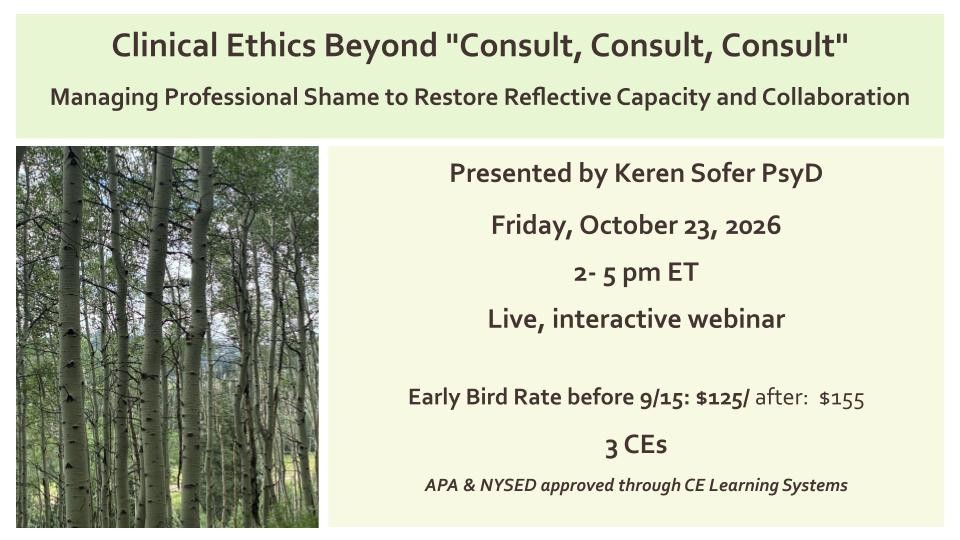
Clinical Ethics Beyond "Consult, Consult, Consult": Managing Professional Shame to Restore Reflective Capacity and Collaboration
Keren Sofer, Psy.D.
About this training
As a moral affect, shame has a crucial function in signaling that we are approaching the guardrails of professional conduct. But when shame leads to avoidance or concealment, we become trapped in an untenable bind: the very exposure that would help us navigate a complex situation feels too risky. Most ethics trainings emphasize compliance and decision-making rubrics—reinforcing the guardrails, and encouraging consultation when in doubt, but completely sidestepping why we fail to seek help when facing ethically ambiguous situations in the first place. This workshop fills that gap by addressing the affective side of ethics head-on by addressing these questions: How does shame theory help us understand why we hesitate to disclose mistakes, set necessary boundaries, or have difficult conversations with clients? What do we do when professional shame—conscious or disavowed—interferes with our willingness to expose uncertainty to colleagues, leaving us vulnerable to ethical drift? Intended for all levels of clinical experience, this intermediate level program will utilize an interactive, experiential approach, integrating discussion, video, and breakout groups. Course Objectives: * Explain shame's evolutionary and relational function as an affect that signals boundary crossings, ethical transgressions and other ways that one has violated group norms. * Analyze ways that disavowed shame can result in a breakdown of our ethical signaling system which can lead to ethical drift, ethical violations and concealment. * Utilize evidence-based counter-shaming strategies to reengage reflective capacities and self-regulate in order to manage professional shame. * Evaluate one's readiness to pursue ethics consultation by using specific behavioral and physiological indicators to determine when reflective capacity has been adequately restored. For NYSED participants, this program provides general CE credits; please note it does not satisfy state-specific NY ethics requirements. Please check your specific state guidelines regarding whether this program qualifies for general CEs or Ethics credit.
CE credits: 3 · APA, NYSED